Dead-Simple OSR Solo Gaming
I've had a bunch of stops and starts with OSR solo gaming over the years, and these have been my main points of friction:
- While OSR games and the PCs therein are a hell of a lot less crunchy than in most newer systems, I’ve still found the level of complexity and fiddliness too high to effectively run a roster of characters.1
- Systems that are there to supposedly help the solo gamer - generators, oracles, etc. - tend to create yet more overhead by muddying systems and making decision points more time-consuming.
As a solo gamer, I’m juggling a party of characters, and creating the fiction, and trying to maintain some sort of sense of fair arbitration. It’s a lot to handle.
Lately my solo sessions have been getting smoother, though, and I think there are two main reasons for this:
- A merciless simplification of the ruleset.
- Leaning into the main strength of old-school games: their procedures.
Contrary to the notion that, to play a solo game, you need extra rules and extra systems, I’ve found that the actual key to success has been distilling my rules and my tools.
Below I’ll outline how I've gotten to a place of fairly successful, simple and portable arcade gaming. This is not a guide to playing out cinematic stories of heroic fantasy, but if you are interested in the OSR dungeon crawl, read on.
I’ve been playing with my little wallet-sized OD&D hack I’m calling Coinpurse Crypts (the link is to Google Drive; I'm not trying to sell you a product). You can transfer this stuff to other systems, but Coinpurse Crypts basically fulfills all my solo gaming needs for the time being, and I’ll be referring to it extensively.2

Characters
Run simple characters. Your entire character roster should fit on a single page of your notebook. Characters should be very simple and their generation should be as fast as possible:
- Don’t use the full six attributes and their myriad of fiddly little modifiers to other parts of the rule system (how many hirelings you can have; your resistance to magic, etc. - this sort of cruft gets tough in solo play). I like three attributes - or you can skip them entirely and just rely on the classes.
- Replace multiple dice with a single one wherever possible. The fewer dice or types of dice you need to play, the better. Coinpurse Crypts plays with a d6 and a d20 (that includes all tables and generators).
- Replace rolls with rules. Two examples from Coinpurse Crypts: instead of rolling 3d6 for an attribute, I just roll a 1d6 for the bonus; and HP per level is not rolled but defined by class.
- Roll starting equipment randomly. Buying gear is the most arduous part of character creation.
Even in Coinpurse Crypts, which is super stripped down, it still takes me like 20 minutes to fill out my little character roster. I urge you to minimize this sort of setup as much as possible.
Run three PCs and three simplified hirelings. This was a big one that I picked up from everweird’s solo Gunderholfen game. Instead of running 6-8 full-fledged characters, he has a separate hireling sheet for fighter-types: no stats, no inventory, just equipment and HP, basically. I actually recommend you take this one step further: don’t even track their XP3, and have them all equipped with the exact same stuff. Keep your three hirelings mechanically identical.
This gives you a party:
- that’s big enough to be combat-effective;
- that you won’t go crazy logging and running (managing six inventories sucks!);
- where your three full-fledged PCs have more room to shine.
You can grab everweird’s sheets here. I don’t use them, but they’re a jumping-off point.
Rules and Subsystems
You should know your system, and your system should support you. You don’t want to be checking the rules often: it breaks flow and creates overhead. Annoying enough in a group game, significantly disruptive in a solo game. The good thing about minimalist hacks like Coinpurse Crypts (or FMC Basic, or Cairn, or whatever) is that there aren’t many rules to begin with, and you can safely rely on rulings. Don’t get bogged down.
Preferably your ruleset is well laid out, and you’re required to do minimal page-flipping. All the monsters in Coinpurse Crypts are on a single spread; so are all the spells. And if everything you need is in one booklet instead of multiple books, your game becomes portable: you can play it in bed or in the park. I don’t want to clear the dinner table to play a short solo game session.
Cut unnecessary subsystems. Especially those that require constant counting or logging. A few examples from Coinpurse Crypts:
- No variable speed and no grid counting. Combat is theater of the mind (setting up grid battles takes too long; believe me I’ve tried). Dungeon exploration is a pointcrawl: turns pass based on rooms explored, not on distances traveled.
- Arrows, rations, bedrolls, waterskins, firestarters and other basic equipment are not tracked. If there’s ever a reason to track this stuff (water in a desert, for example) - then you can start worrying about it. Until then, handwave. This significantly simplifies inventory management.
- In a simplified variation of the overloaded encounter die, torch timers are not tracked; torches simply go out on a six on the random encounter roll. Again, simplifies timekeeping and inventory management.4
Solo Tools
Your ruleset should provide clear solutions. I mentioned before that minimalist hacks are good for having light rulesets, but here’s where they tend to trip up: they’re often not complete games. They might lack bestiaries or spell lists, for example.
When I roll a random encounter, I don’t want to follow the ten-step monster creation procedure; instead I want a list of monsters one encounters by biome or by dungeon level. Play a game that has a complete bestiary and clear procedures for monster and treasure stocking.
Solo-gaming-specific rulesets and supplements tend to be among the worst offenders in bogging every decision point down in bespoke random generators and spark table rolls. This is done in the name of variety but grinds the game to a halt.
Oracles are mostly unnecessary. Try not to use one whenever possible. If there’s a decision point, try to go with the first idea that comes to mind. Don’t worry about fairness or going easy on yourself - I tend to be harder on myself in solo games than referees are on players in a normal game. It’s an overcorrection.
The police aren't going to knock your door down if you give your team an edge occasionally.
Don’t worry, also, about your ideas seeming stupid. You’re not writing a novel. You’re playing a game - one of exploration, problem-solving and combat. A mediocre, quick decision is more conducive to the game than a considered, belabored one.
When I do need the dice to weigh in, these are the only oracular rolls I use (on a d6). Define your options and roll:
- Two options: 1-3:A, 4-6:B. No ‘likely/unlikely’ modifiers - allowing for fiddliness invites overanalyzing.
- Three options: 1-2:A, 3-4:B, 5-6:C.
- Likely/unlikely/rare: 1-3:A, 4-5:B, 6:C.
Always try to roll just once; don’t keep asking questions about the situation. Feel confident about constructing a situation after zero to one questions for the oracle - because, again, the idea doesn't have to be brilliant.
If the result of a coin flip makes you realize that you actually wanted the opposite result, just take the result you wanted.
Instead of oracles, rely on OSR procedures. If you take one thing away from this post, it should be this. Dungeon turns, random encounter rolls, etc., are the backbone of any OSR game - a solo game is no different. I don’t need oracles creating twists and turns when I have these procedures - that’s pulling double-duty and creating unnecessary work. Trust the procedures. They’re foundational to the game and don’t need your help. They’re perfectly capable of creating an interesting game state and an interesting fiction.
Random encounters. Write an empty d6 table next to where your map will be.5 When you roll a random encounter, or you roll a monster room, add that creature to the encounter table. When you roll a positive reaction, have the creatures share information with the player - pre-roll a random encounter or a location. This way, the central procedure of the game is helping you build an ecology and a space. The basic gameplay loop is pulling oracular duty.
Quick and meaningful dungeon generation. Two things your generator should accomplish: that entering a new room does not take ten minutes of rolling dice, and that rooms have thematic and geographic relations (linear dungeons suck).
The dungeon generator in Coinpurse Crypts (cribbed from Marcia B.) accomplishes these goals surprisingly well - despite the fact I didn’t intend it as a solo tool initially.
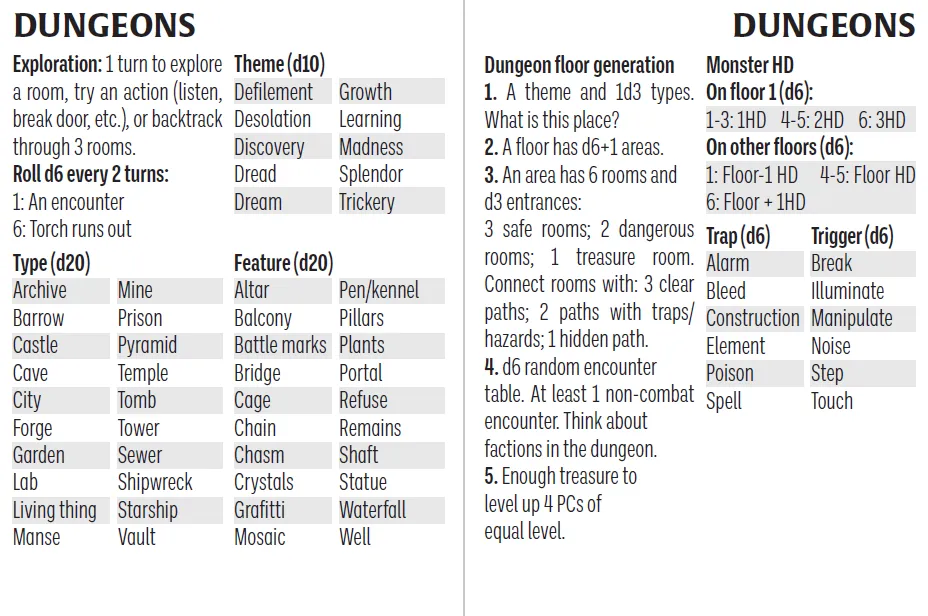
With this method, we know right off the bat how many areas the dungeon level consists of, and what types of rooms we’ll find in each area. This is meta knowledge, sure, and you’d think you want the surprise of pure randomness. But what the pseudo-random and predictable nature of this generator allows you to do is to make inferences, and that creates interesting gameplay.
An example from my solo game:
- I know my level consists of six areas, and I’m exploring the margins of it.
- I roll lizardmen in a room that wants to connect to another area of the dungeon.
- I assume the lizardmen are guards, and that the area beyond is their lair.
- Their lair happens to be the central area of the dungeon (I know this because I already know the bounds of the dungeon). This gives me the idea that the lizardmen have a dominant position on the level.
- I now know to avoid the central area.
You see how having some foreknowledge of the shape of the dungeon level helps extrapolate a whole fiction - and strategic gameplay! - much more than a truly random dungeon generated one room at a time?
On Playing
Pen and paper instead of the computer. You can write chicken-scratch, scribble, draw arrows, tables and sketches. Computers are unintuitive. Don't worry if your notes are a mess. Like I said earlier, you’re not writing a novel; and you’re not playing to post pictures on Reddit afterwards. It’s a solo game - definitionally, you are the only one who needs to understand any of it.
And, again, if you shoot for a small and deviceless form factor, I encourage you to play outdoors!
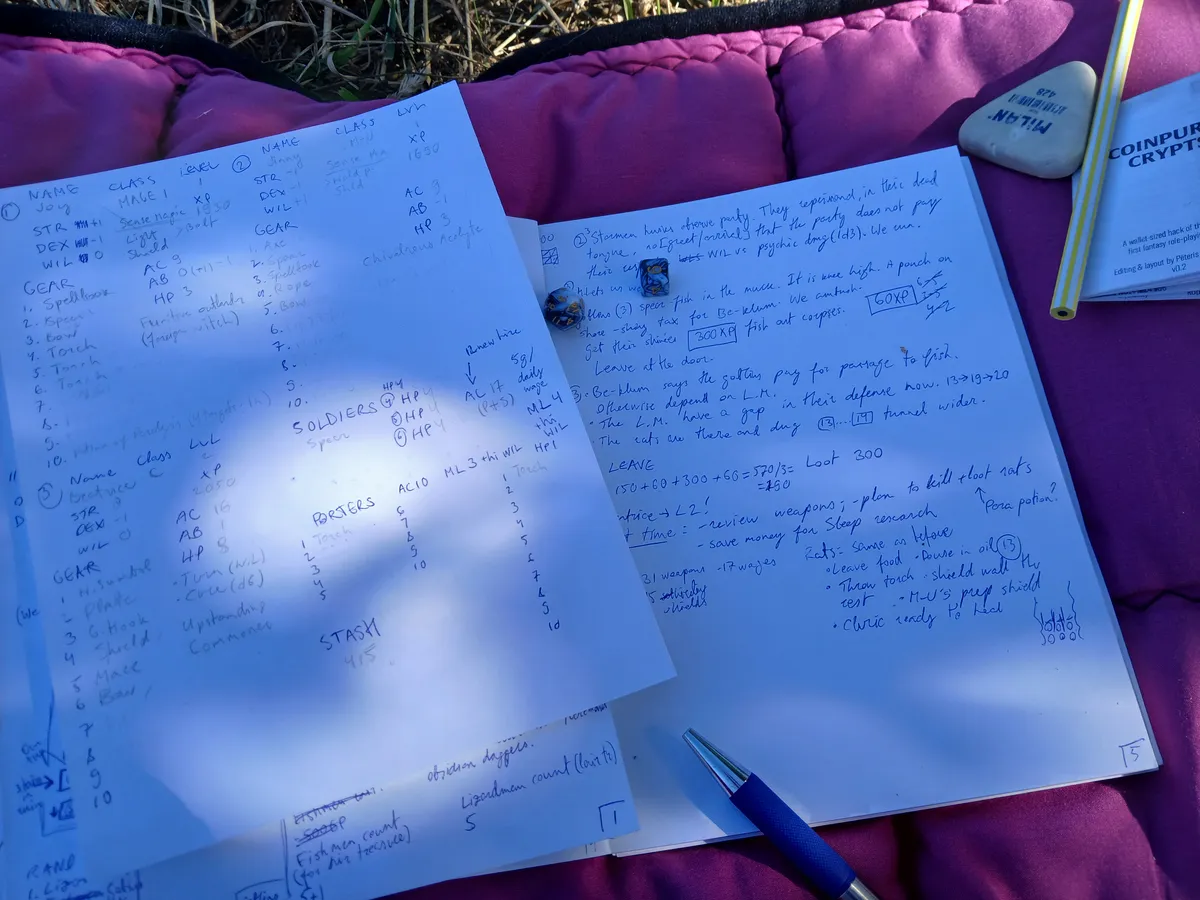
The map is the backbone of your notes. Or, more obtusely: align your notes with your mental model. You’ll see what I mean.
This is another trick I picked up from watching everweird: even though he runs written modules, he redraws the maps. This mirrors the experience of player mapping, for one. You’re spending less time looking at the module and spoiling yourself.
Logging my notes by room number makes a lot more sense than logging by time. Instead of a note saying “11:30: 6 goblins in Room 8”, I suggest formatting it as “Room 8: 6 goblins”. Where something happens in a dungeon is more important than when it happens. When you share RPG war stories, do you say “Remember when we did the thing in the big cistern?”, or do you say “Remember when we did the thing at noon?”
Bend any and all of the rules above. I've asked an oracle more than one question. I've brought in more than three hirelings. I've not added a boring monster to my random encounter table. It’s your game and no-one else's.
If you want to play a solo dungeon crawl, don’t get bogged down in unwieldy systems and don’t buy into notions of what a solo game needs to be. You don’t need supplements and a million bespoke generators. You don’t need oracles attempting to narrativize your game. Remember that OSR games are defined by procedure and emergent storytelling. If you trust that in a group game, trust it in a solo one as well.
Love you!
Speaking from experience with the following games: Basic Fantasy RPG and its unofficial Solo Hexcrawl Supplement, White Box: FMAG, and the underrated solo-focused Knave hack FORGE.↩
I’m standing on the shoulders of giants here. FMC Basic by Marcia B. was particularly influential on my hack.↩
Either your hirelings forever have 1 HD, or you can train the whole group up as a downtime activity or something.↩
Or perhaps light management is a sacred cow, and can be cut entirely.↩
I like to fill in entry #6 as “Combine two” in all my random encounter tables.↩