Faction Procedures: A Comparative Review
I recently purchased Cy_Borg, and started thinking about implementing a faction turn procedure to simulate the game’s 14 economically but evocatively described megacorps. Since Cy_Borg has no built in procedure for this, I'd need to plug something in.1
For the uninitiated, these are procedures you use to see how and when the power players in your campaign achieve their goals. The referee has a faction document with a list of factions, and goes through the faction procedure at some regular interval (either every fortnight or month of in-game time, or when PCs take downtime, etc.). As factions accomplish their goals, the game world changes: the invaders sack a town; the Queen marches her troops; the Necromancer loots the ancient library; the Church discovers their lost temple; and so on. I love how these procedures add a dynamic political layer to the sandbox.
I already use faction turns in my ongoing Dolmenwood campaign, but I’m not fully satisfied with my current approach (more on that later). So, I decided to explore some of the most commonly discussed faction systems in OSR circles. Below is a comparative review of the systems presented in:
- Worlds Without Number
- Blades in the Dark
- Mausritter
- Cairn 2e
- The Blogosphere
I'll be judging these on maximum utility versus minimum work. I find these procedures very useful, but they're also ultimately background. That should be reflected in the demands they make of the referee.
To test these systems, I’ll use Alliansen Inc., one of Cy_Borg’s megacorps. Here’s what the book tells us about this faction:
Alliansen Inc. Factsheet
Primary fields of operation: Real estate, security, entertainment, behavioral analytics, voting, research
Secondary fields: sports, financial services, staffing, AI, communication, cybertech
NPC: Mrs. Lia, President of the Board
NPC: Jaci F. Ah, Head of Security Operations
Location: Majority shareholder in Borghold Prison Complex
Location: Partial control of and HQ in South Central (the main business district of Cy_)
Detail: At war with UCS
Detail: Leasing infrastructure to half of Cy’s SecOp
My read: this is a clandestine conservative-authoritarian org infesting all facets of the political and security apparatus like a cancer. Like Palantir, Cambridge Analytica and a PMC rolled into one. Their propaganda work, and their control of critical infrastructure like elections and security means that they operate basically like a shadow government.

Worlds Without Number
The big progenitor, as far as I can tell, of faction procedures in OSR games of the past ten years, WWN gives the referee a complex boardgame and asks them to play it solo. Factions have stats and HP, pay upkeep, maneuver and activate their Assets on the campaign map (hero units, basically: they have their own HP, stats and special abilities), follow an involved turn procedure, and pursue goals that read like strategy game objectives (“take X location in Y turns to earn Z points”).
There are rules for ability checks and movement; there are tags further modifying faction and Asset behaviour; there are about sixty different Assets, each with a paragraph describing its own little mechanic.
Maybe this is a good boardgame - I didn’t test it -, but as a referee tool, I find it misguided. Making a faction takes like an hour and feels like building a Pathfinder character. Instead of building the faction’s identity and thinking of its goals in fictional terms, I’m navigating lists upon lists of gameplay mechanics, and modifiers to those mechanics, and tags, and objectives, trying to put my square peg understanding of a faction's identity into the round hole of WWN's mechanics.
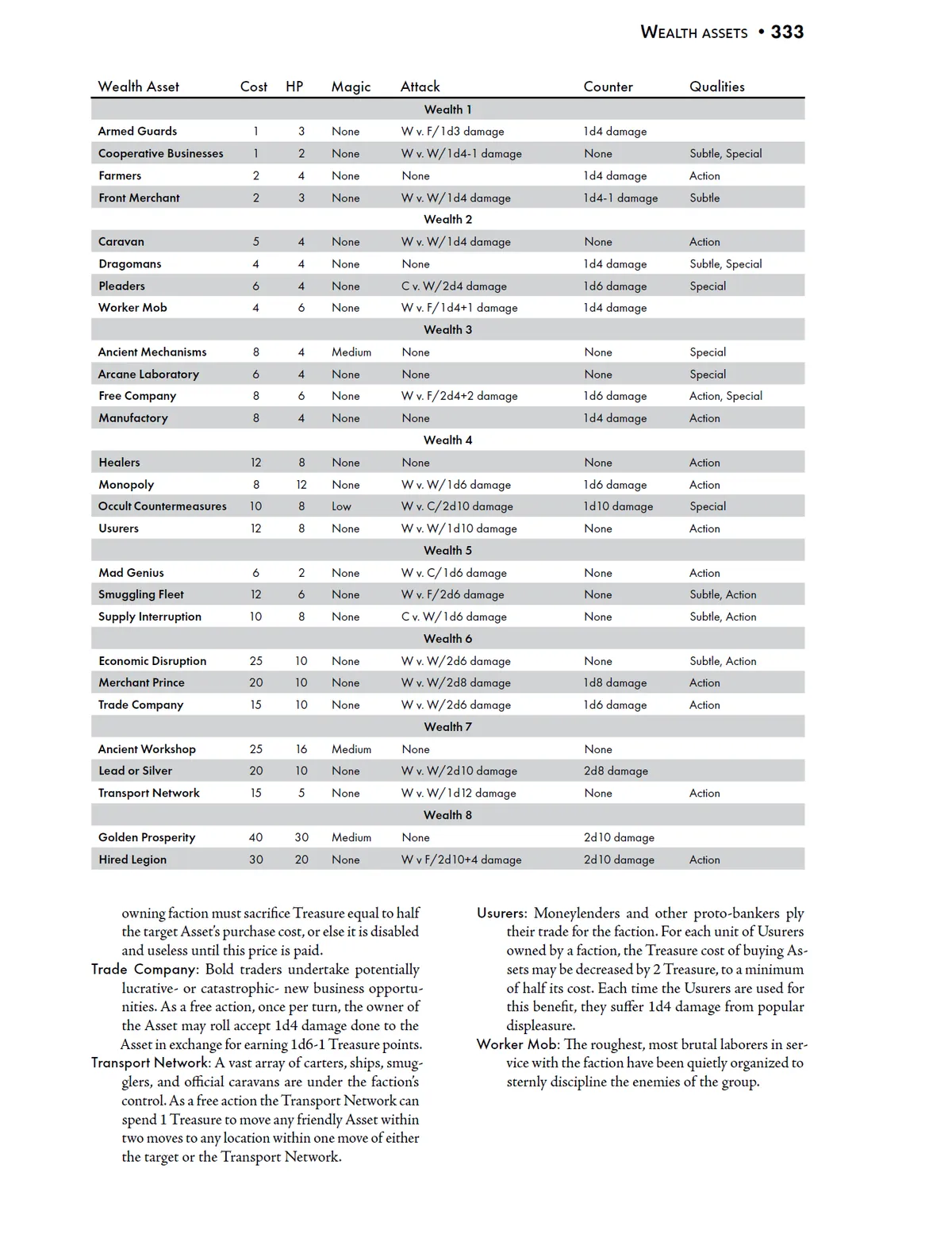
Beyond being a lot of work, I don’t understand who this serves. If I was hardcore about simulating factional conflict, I’d probably use henchman missions from AD&D, mass battle rules from a wargame, etc., because WWN’s system is still abstract and boardgamey. Meanwhile, a low-prep referee like me is asked to engage with a complex system when I’m just looking for something to gently push the game world along. The system lands in an uncomfortable middle.
Alliansen Inc. (Worlds Without Number)
Large faction
Cunning: 8 Force: 6 Wealth: 4 Magic: 12 Treasure: 0 (the book isn't clear on starting Treasure)
HP: 38ASSETS
Cunning:
Blackmail (HP 4; Subtle; Special): When this asset is present, hostile factions can’t roll more than one die when attacking or defending during an attack action.
Interrupted Logistics (HP 10; Subtle, Special): Non-Stealthed hostile units cannot enter the location of this asset without paying 1d4 Treasure and waiting one turn to arrive there.
Just As Planned (HP 15; Subtle; Special): Whenever the faction’s Assets make a roll involving Cunning, they may reroll a failed check at the cost of inflicting 1d6 damage on Just As Planned.
Petty SeersAnalytics (HP 2; Subtle):A cadre of skilled fortune-tellers and minor oraclesAI tools and data analysts have been enlisted by the faction to foresee perils and allow swift counterattacks. (No concrete game mechanic explanation for this??)Force:
Brilliant GeneralCSO (Jaci F. Ah; HP 8; Subtle; Special): Extra roll for attacking or defending for all friendly units (incl. this one) in the location.
InfantrySecOps (HP 6): Common soldiers.Wealth:
Monopoly (HP 12; Action): Forces Treasure payments for enemy assets.
Supply Interruption (HP 10; Subtle; Action): Forces enemy factions to pay Treasure to not have their Assets disabled.GOAL
Eliminate target: Kill the Gail couple (U.C.S lead weapon designers) within 3 turns. Difficulty: 1
Blades in the Dark
A storygame with a major focus on faction play, its big contribution to the OSR is Progress Clocks3.
Each faction has a long-term goal, defined by a clock with 4-8 segments. The clock advances by filling in segments. When the PCs take a Downtime Action, the referee advances whichever faction clocks they (the ref) are interested in. PCs can directly aid or interfere in these. That’s it.
Faction goals represented as clocks is the foundational idea of most of the other systems we’ll look at. Advancing those clocks during PC downtime is a good rule of thumb even in other procedures. What’s missing for me is a procedure for when the clocks advance. Here, it’s left to GM fiat. The whole point of proceduralization is to avoid that.
There is an actual faction system in the game as well, but most of the mechanics focus on the factions in relation to the PCs. Factions are tiered by their power, and have a Strong or Weak Hold on that power. The PCs climb tiers and weaken enemy factions. The referee tracks the PCs’ reputations with the different factions (in an OSR game, we could use this modifier for reaction rolls).
For my faction procedure, I’m more interested in how the factions affect the world, not how they relate to the PCs, so, while I don't doubt the faction system works well in Blades, I don't have much to pilfer here. But Progress Clocks are a keeper.
Alliansen Inc. (Blades in the Dark)
One of the most powerful megacorps in Cy, Alliansen Inc. controls critical security and election infrastructure, and has a powerful R&D wing focused on behavioral analytics and propaganda. They have their tendrils in most facets of Cy politics and SecOps, and are attempting to wield that power to destroy their competitor, the security and weapontech juggernaut UCS.
Tier: V Hold: Strong
PC reputation: 0 (Neutral)
Long-term goal: Poach or assassinate the Gail couple, UCS’ head weapontech developers 0/4
Mausritter
The gold standard since it came out, Mausritter presents a full procedure built around BitD's clocks. Factions have a list of goals that they tackle in order, and advancing the clocks is resolved via dice roll. Factions also have a short list of broadly-defined Resources which can help accomplish goals quicker (adding +1 to the roll per relevant Resource).
When I started my Dolmenwood campaign in early 2024, the standard piece of advice you’d read was to use the Mausritter system roughly as outlined in this d66kobolds blog post.
For my part, I immediately found the Resources a little difficult to work with, and basically ignored them. There were a few reasons for this:
- If we’re defining a faction by three or so Resources, they’ll be broad strokes most of the time. Meanwhile, the goals should be fairly granular. It's not always obvious whether the broad resource should apply to the particular goal. I second guess myself a lot, so I found this uncomfortable.
- The goals of a faction are going to be aligned with their resources 90% of the time. A militaristic power is going to go to war. A wizard is going to do magical research. Cutting the Resource bonuses would not lose any fictional fidelity.
- Ideally, factions should be targeting each other a lot to create a dynamic political situation. This means +1 bonuses and -1 penalties cancelling each other out, and we end up back at an unmodified roll. That means a 50% failure rate, which I consider quite steep (because we want things to happen in our sandbox!).
So I find the Resource aspect a little in the weeds, and the math a bit off, but overall this system is a success. It's a well-defined, lightweight engine that gets our world moving. Its great triumph is that it's the first framework we've looked at that actually helps the referee reason about the factions. The previous systems were abstract in defining a faction and gave no trajectory for its goals.
ALLIANSEN INC. (Mausritter)
Resources:
Leverage: they lease infrastructure to half of Cy’s SecOps
Political influence (analytics and election infrastructure)
Social engineering tools (behavioral analytics and entertainment assets)Goals:
Hijack ACGS firestop system (guns disable when pointed at C-class execs) for own use: ○○○
Poach or assassinate the Gail couple (UCS head researchers): ○○
Manufacture advanced weapontech: ○○○
Destroy Citadel Tower (UCS central HQ): ○○○○○○
Cairn 2e
Cairn 2e takes the rough outline of the Mausritter system, and - oddly - makes it both more grounded in the fiction and more abstract in its mechanics. There’s interesting stuff here, but I ultimately find it a tad unwieldy.
Factions have Advantages (roughly equivalent to Mausritter’s Resources), an Agenda (containing a more granular set of Goals), Obstacles, and NPC Agents. A real strength of this system is how it asks the referee to think about Agendas and Goals. Namely, the guidelines state that at least one Obstacle should stand in the way of each Agenda, and at least one Goal should deal with that Obstacle. The most natural way for me to go through the procedure ended up being:
- Come up with the Agenda.
- Infer the Obstacle(s).
- Come up with Goals which neutralize Obstacles and push towards fulfilling the Agenda.
We’re immediately creating a situation with levers and hooks, and we’re asked to model a faction that’s strategic about its ambitions. The system forces us to write goals that are less wishlist and more plan than in Mausritter.
That's cool! And yet, a few wrinkles:
First and foremost, I want factions to be a change engine. I don’t necessarily need their plans to make perfect strategic sense. But Cairn asks me to really scrutinize the strategies - that’s more prep. I'm all about doing as little as possible, so while Cairn presents a good exercise, I don't think it's a strictly necessary one. And you'll be doing yet more work after setting the faction up.
Every faction turn, we roll on a d6 resolution table with options like new Obstacles appearing, or Advantages lost and gained. Cairn does helpfully provide us with d20 spark tables for new Advantages and Obstacles, but it means you're continuously revisiting your faction sheet, and trying to come up with yet more ways that the faction's situation changes. I don't think the players will ever see 20% of this stuff. Maybe with a really disciplined referee they would, but I ain't it4.
Further, the resolution system doesn't really utilize the work we just put into building a believable faction. On any given roll, there’s a 3-in-6 chance of losing an Advantage5. Because Advantages are not directly used to advance goals (like Resources in Mausritter are), they feel almost like a disconnected currency. On an unsuccessful roll, you can end up in a situation where you’re crossing off an Advantage totally unrelated to the attempted Goal. It's all quite random.
Is this system about strategy and simulating cause-and-effect, or is it just making faction states change randomly? I’m fine with either approach - randomness could be fine for the level of fidelity a faction system actually needs. But if it's random, then why did I do the strategizing?
ALLIANSEN INC. (Cairn 2e)
Type
Rulers. Alliansen Inc. have their grip on much of the political and security apparatus of Cy.
Advantages
Charisma: Political and social influence via elections and propaganda.
Information: Analytics tools and R&D.
Position: they lease infrastructure to half of Cy’s SecOps.Agents
Mrs. Lia, President of the Board. WIL 146
Jaci F. Ah, Head of Security Operations. WIL 13Agenda
Destroy UCS capacity to fight back, then destroy them.
- Hijack ACGS firestop system (guns disable when pointed at C-class execs) for own use.
- Poach or assassinate the Gail couple (UCS head researchers).
- Manufacture advanced weapontech
- Blow up Citadel Tower (UCS central HQ)
Obstacles
- UCS has proprietary automated weapons platform tech.
- UCS is more militarily powerful.
Bonus Round: The Blogosphere
Among Cats and Books takes Mausritter as their base, but gets significantly more granular, splitting a faction’s actions into a campaign-spanning Goal, mid-term Missions that advance the goal, and short-term Tasks that advance the Missions. Like Cairn, we’re asked to think more strategically again: what are the actual steps a faction takes to achieve its goals? Like Cairn, I like it in principle, but would be careful not to overthink.
Patchwork Paladin proposes a new resolution table for advancing clocks. I switched from the Mausritter system to this one in my Dolmenwood campaign, as it gets rid of modifiers from Resources. However, I’ve found the failure results a little punishing. I rolled a few 1s and 3s in a row for a couple of factions, which led to cascading failure. I want factions to succeed at their goals at a good clip.
GFC’S DND boils factions down to this sentence:
“[FACTION] wants [MOTIVATION] but [OBSTACLE]; therefore, [METHOD OF SURMOUNTING OBSTACLE]”.
I think this is a brilliant framework, but it’s not a procedure per se. I can see this working great if you’re playing in a slightly more static or smaller-scale world - the author specifically refers to dungeon play -, but for a game like Cy_Borg or Dolmenwood, I want a procedure that has memory and ways to measure progress.
Verdict
OSR nerds (company included) love working on little subsystems. Adding a faction procedure to your ruleset is an excuse to make a minigame and invite referees to have Solo Fun. But this ignores the basic reality that these systems will almost always be background. It’s not where the gravity of play will be, ergo, the attention is misplaced. A faction procedure should demand as little referee attention as it can be while still accomplishing its basic goals.
To me, those goals are:
- To create a dynamic world as conceivably experienced by the players - introducing rumours and quest hooks; modifying random encounter tables; changing the content of hexes or the prices of goods; introducing and disappearing crucial NPCs; etc.
- To do so quickly: unless you’re doing 1:1 time, in my experience, months will pass in real life over the time that weeks do in-game. The faction system needs to account for this and not be mathematically geared toward a static world.
- Optionally, to do so slightly unpredictably: I want to start the engine without knowing where it will end up; to let procedure take over.
- To help the referee get a feel for the factions. Through playing out the procedure, a faction can come alive in the referee’s mind beyond just the initial writeup, and spark new ideas.
To achieve these goals, we don’t need compelling minigames and we don’t need simulation. We just need something quick that lets the factions gradually affect the gameworld.
I don’t think I’d want to use any of the systems we’ve looked at as written. Call me a simpleton, but each one of them either adds at least one wrinkle of complexity too many, or fails in helping me build a sufficient - and simple - fiction.
My Proposal
Mausritter is almost there. Here's how I'll be modifying it:
- To define the faction for ourselves clearly and to help in setting goals, write a tiny description, note an overarching agenda, and optionally make a little list of strengths or weaknesses. Take a note from the strategic thinking that Cairn and GFC’s DND encourages, but don’t try to systematize it.
- Get rid of the Resource bonuses (unneeded fiddliness)
- Change the chance of success from a flat 3-in-6 to a 4-in-6, and keep the chance of two successes on a 6.
So maybe Alliansen Inc. looks something like this. A quick writeup and Mausritter goals:
Alliansen Inc. controls much of the critical security and election infrastructure in Cy, and has an R&D wing focused on behavioral analytics and propaganda. They have their tendrils in most facets of Cy politics and SecOps.
They are attempting to wield that power to destroy security and weapontech juggernaut UCS. UCS is more militarily powerful, so Alliansen needs to use subterfuge.
Goals:
Hijack ACGS firestop system (guns disable when pointed at C-class execs) for own use: ○○○
Poach or assassinate the Gail couple (UCS head researchers): ○○
Manufacture advanced weapontech: ○○○
Destroy Citadel Tower (UCS central HQ): ○○○○○○
Parting Advice
Here are three lessons I’ve learned from using faction turns in my Dolmenwood campaign:
WWN, Mausritter and Cairn all caution against running too many factions, but don’t say why. I assumed it was because managing many factions would be too complex. While that may be true for WWN, it wasn’t the case for Mausritter. What I actually found is: in a large setting, there’s no need to start them all on turn 1. Your players won’t encounter 80% of the world or factions anyway. So start only with the ones relevant to the PCs or their region, and introduce others as it makes sense. Any campaign will naturally focus on a few factions, with the rest only adding background detail.
time in the game world is even more elastic than in real life. In Dolmenwood, I usually run faction turns every two in-game weeks, but I stopped sticking to this rigidly. If we’ve been playing for three months, and only three days have passed in-game (missed sessions, dungeon crawls, etc.), I’ll trigger a new faction turn early - usually between adventures.
When the players interact with a significant NPC, add them to your faction tracker. Players really respond to recurring NPCs who pursue their own agendas. For example, my party released a manticore from its prison in session 2 or 3. Forty sessions later, they encountered it again, having heard rumours about what it was up to all along the way. This truly made the world feel alive. The players clearly felt their impact.
This is the end. Thank you!
I’m sure that some fans would say that this runs counter to the fast and loose spirit of the Borg games, or that it’s redundant with the built-in event system, but I’m less interested in Cy_Borg for its burn-it-all-down ethos than for its setting and ruleset.↩
Cy_Borg has thinly veiled magic powers in the form of Apps and Nano Powers (you control little infected nanobots in the air or something).↩
I think Apocalypse World is the first game to feature Clocks, strictly speaking, but I never see it referenced. BitD is the standard-bearer.↩
Leafing through Cairn many times over the years, I've always gotten the sense that, despite being rules-light, it really demands an experienced and creative referee - perhaps one versed in storygames.↩
There's only a 1-in-6 chance of gaining an Advantage, so if we let the system just run by itself, factions are eventually going to run out of Advantages.↩
Agent WIL is used for resolving opposed faction actions. Generated using 4d6 drop lowest.↩