Failure with Gradient Descent
Warning: spoilers for Gradient Descent in this post. It'll make more sense if you're familiar with the module.
I ran five sessions of Luke Gearing’s Gradient Descent last year, and they kind of sucked. It’s a celebrated module and I’m a decent referee, so what gives?

Logistics and Inexperience
There were only three players initially, so scheduling was difficult. Sometimes we’d only play once a month or so, which really messed with the players’ investment and decision-making abilities. This is especially bad in a megadungeon, where players are dealing with a lot of information density and interconnection.
We were also all new to Mothership, having only played two sessions of Daniel Hallinan’s (excellent) Bloom previously. This meant that the mental load compounded: I was running a module I had some issues with, while my players were trying to remember previous sessions, and on top of that we were also all occasionally stopped in our tracks to look up rule clarifications. We struggled to get into a groove.
But as I was reflecting on the experience, I also realized that the module’s author has made a series of creative decisions that made it tougher for me to run. I thought those might be interesting to explore.
Mismatched Expectations
My favourite adventure modules tend to have the following in common:
- A verisimilitude and sense of place or history. I love players being able to reason about the environments they explore, and for those environments to get their hooks into the players. It does wonders for player agency and engagement.
- An ‘adventure as technical manual’ philosophy. I don’t mean that I’m a stickler for layout or writing style; however, I don’t want to run a module that requires a lot of assembly or interpretation.
Gradient Descent slightly blindsided me on both fronts – I think due to its production quality and presentation, and its position as one of the flagship Mothership modules. Mothership has a reputation for slick, focused and playable releases. Because of the Mothership sheen, I didn’t pick up on some aspects of Gradient Descent’s writing that I should have recognized as being not for me.
Writing Style
Luke Gearing is an evocative writer, but I struggled with how he structures and prioritizes the information in this module. Let’s look at this room key on the first floor as an example:
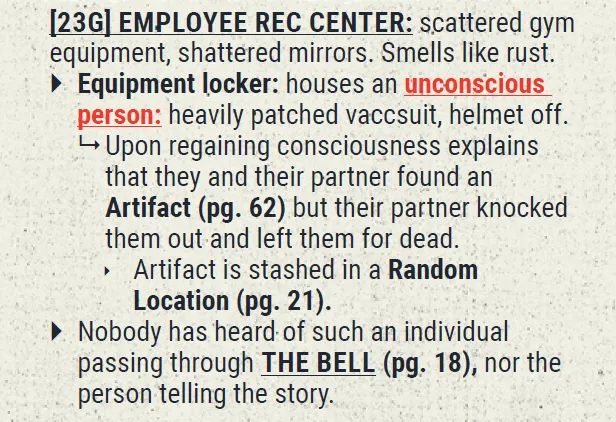
The key is written as a mystery. It’s intriguing on the page but a little confusing for a new warden. The implication here is that the NPC is one of the infiltrator androids created on the station; otherwise, the situation makes little sense. I wish Gearing had spelled it out. When I was running this, the android angle wasn’t totally obvious to me because I hadn’t yet internalized the adventure’s themes. Remember: this is one of the first rooms. I ran it fine in the end but with a sense of uncertainty.
You’ll also notice the lack of specific details and a reliance on tables. It’s kind of fine here because this is a room any warden can reasonably expect their players to visit in session 1, and can prepare accordingly. However, if you come across this sort of writing where you haven’t had a chance to prepare, it becomes a bit of a warden trap. The module’s sprinkled with these. The random search table has entries for maps – so you better have those prepared. There are random artifacts in the form of statues and poems – of what, the module doesn’t say. There are random encounter rolls that might suddenly challenge your understanding of the fiction (why are CLOUDBANK employees wandering here?). There were a few times I had to pause our sessions because of random roll results.
There’s a density of plot and procedures in Gradient Descent that made me think I need to stay on script, but at the same time, a lot of the room key leaves crucial specifics up to the warden. A more experienced warden can deal with that tension, but I was second guessing myself and flipping pages in the module looking for clarifications that weren’t there.
Funhouse Content
And then some of the stuff just didn’t make sense to me.
Going back to my preference for modules with strong verisimilitude, I thought I was getting into a Bioshock type of thing, where the location has a clear logic and history; where the environment tells the story; and where players are drawn further into the mysteries of the place.
Gradient Descent hints strongly at this sort of design. The setup is really strong. The overall layout of the location makes sense. So do the motivations and relationships of the various factions, mostly. But it’s only when we started playing that I realized that, when you drill down to the room key, this turns into a bit of a disconnected funhouse dungeon at times. Here’s a room that connects four areas related to the space station’s O2 systems and trash disposal:
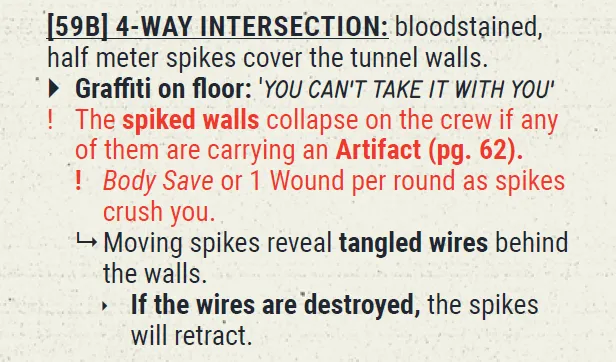
Have these spikes been jury-rigged, or was this already an Event Horizon corridor back when the station was fully operational? Who set this up? What’s with the graffiti? Why here? My players almost entered this room in one of our sessions, and I gotta tell you, I’m glad they didn’t because I struggle running a room I can’t reason out.
Later in that same session, the group ended up in a room where floating pseudo-flesh jellyfish attacked them. There’s no reference to these jellyfish anywhere else in the module. It’s not that I want an explanation for everything. Rather, the problem is that our group found many of these things arbitrary and inexplicable.
Hostility
Finally, there’s a bit of a negadungeon streak here. My overall sense was that the module discourages interaction with itself. For example, there’s a lab on the fourth floor where players can appraise the artifacts they’ve found. This would be a really valuable find. Except that it takes days to analyze an artifact, there’s a chance of accidentally activating the artifact, and the room they need to place the artifact in to begin analysis can only be entered by a hidden entrance from outer space. I get that this is survival horror, but at some point players just stop interacting with the world.
The mean streak combined with the funhouse randomness (combined, of course, with not playing often enough) meant that my players were disengaged and just hated the place and wanted to leave. Their experience of the module was often just exploring punishing room after punishing room, for not much reward (in loot or information).
Lessons Learned
I assume Gearing values evocative writing over ease of use at the table (this is the guy who wrote Vol 2 Monsters &). That’s a worthy approach, and his ideas are good. He leaves things open in ways that pull you in as a reader (like the mystery of the unconscious person), and he’s capable of gnarly horror tableaus in the individual room keys. Gradient Descent is amazing to read. But it's not for me, and it fell flat at our table. I was missing the connective tissue, I didn’t have the juice as a warden to pull it all together, and my players were lost.
My takeaways from this failure:
- If your sessions are sporadic, density and mystery will fall flat;
- Don’t let presentation and prestige misguide you. An adventure writer’s style probably remains the same in a glossy product as it does in a Word doc;
- An adventure can be unrelentingly hostile for only so long before players disengage;
- A module reading well doesn’t mean it’ll play well.
The Mothership campaign continues on. We’re having a good time. We added a player, are playing more often, and I’m running them through homebrew adventures more suited to my preferences.